


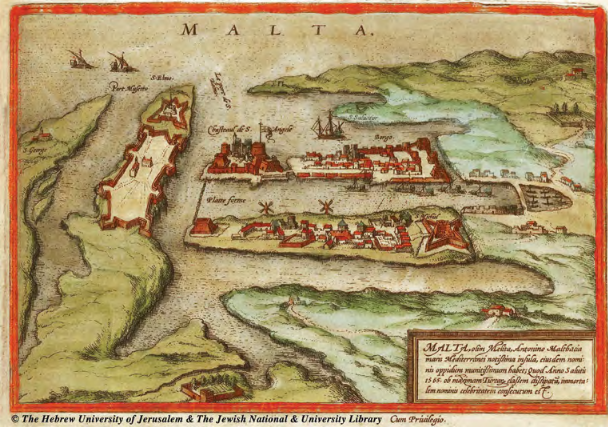
Fort St. Elmo occupies a strategic location at the entrance of the Grand Harbour. As early as the Med ieval period, this fact was recognized and exploited. When in 1530, the Order of St. John arrived in Malta, a survey concluded that the defenses of Marsamxett and the Grand Harbour warranted the construction of a fort right at the tip of this peninsula. In 1551, Grand Master de Homedes ordered the immediate construction of this fort. It was star-shaped and construction took less than six months to completion under the military engineer Pietro Pardo and the supervision of Fra Leone Strozzi. The first Ottoman attack took place on May 28, 1565. After sustaining a heavy bombardment for nearly a month, the fort fell into the hands of the Ottomans on June 23, 1565. The Turkish attack ended destroying massive sections of the fort, and today’s building has precious little left of the original. The Order’s victory over the Ottomans of 1565 led to the foundation of a new fortified city on Mount Sciberras. The fort was enlarged and fitted with barracks, ovens, and cisterns. The city included a reconstructed and enlarged fort
 designed by the military engineer Francesco Laparelli, who also designed the street plan based on the grid system. Fort St. Elmo underwent several additions and alterations over the course of its history, such as the Vendome Bastion in 1614, and later small arms removed from the Palace Armoury.
A number of gun emplacements were constructed between 1919 and 1939 to house new guns. During the Second World War, the fort played an important role in the defence of Malta. It was the element that crushed the Italian seaborne attack of July 26, 1941, on the Grand Harbour. Later in the 1970s, more work was done on the Abercrombie Bastion. The fort has just undergone a multi-million Euro restoration in collaboration with Heritage Malta and covered both the fort itself and its outer parts. This restoration included the on-site chapel of St. Anna and a polverista was added to the same bastion. Carafa Bastions were constructed by military engineer Carl Grunenberg in 1687. Further developments took place during the British period to adapt the fort to the latest military technological and strategic requirements. Of primary importance was the creation of a number of gun emplacements to house the new twin 6-pounder QF (quick-firing) guns, and a musketry parapet that goes on up to the Vendome battery and converting the polverista within Vendome Bastion into a permanent armory to house the dismantling of the National War Museum, which is now incorporated within the New Military Museum. With this restoration to its former glory, Fort St. Elmo takes its place as a jewel of the capital City of Valletta. The Lower part of Fort St. Elmo is scheduled for restoration and is at this time closed to the public.